
Speakers

Speakers

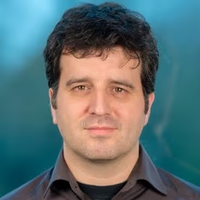
Syamak Nazary   

Syamak Nazary

Business Development Director at Axelera

Syamak Nazary is an experienced business development leader with more than 12 years of international expertise in the technology and semiconductor sectors. He specializes in strategic growth, ecosystem development, and bringing innovative technologies to market. Over the course of 8 years at Intel, he led transportation and automotive initiatives with a strong focus on edge AI projects. With a passion for transformational partnerships and long-term market strategy, Syamak combines industry insight with innovation-driven leadership. He holds an MBA in Strategic Innovation Management from the University of Groningen.


Transforming Industries with Edge AI — Session 2, 11:15–11:30
Edge AI is transforming industries by enabling distributed computing and intelligent applications directly at the point where data is generated and actions are performed. As AI models become increasingly complex and computationally demanding, the need for higher performance at the edge continues to grow. At the same time, edge systems must preserve their core characteristics—low power consumption, minimal latency, and efficient real-time processing. Balancing these requirements is critical to unlocking the full potential of next-generation Edge AI solutions. In this session, you will see how Axelera AI is supporting the balance with some real-life use cases.


Firew Siyoum


Product Architect at Signify

Dr.Ir. Firew Siyoum is an experienced research and development professional with academic background and industrial expertise in embedded firmware and IoT systems. He holds a BSc in Electrical Engineering, and an MSc and PhD in Embedded Systems. He currently serves as Product Architect at Signify, a global leader in lighting systems, where he is responsible for the development and deployment of embedded sensor nodes in connected Smart Building systems. His work spans from low-level firmware on resource-constrained microcontrollers to wireless protocol integration and system-level behavior design.


Edge AI for Anomaly Detection and Self-Correction in Smart Lighting Systems: Opportunities and Challenges — Session 2, 11:30–11:45
Smart lighting systems depend on multiple heterogeneous sensors and wireless protocols to autonomously control light output. The application logic for light control is mainly through embedded state machines and algorithms that run on resource-constrained microcontrollers. In real-world deployments, these systems face degraded behavior caused by faulty sensor readings, unhandled corner-case scenarios in multi-source occupancy fusion, and wireless packet loss due to RF interference and network congestion. This talk explores the opportunities and challenges of leveraging Edge AI techniques to detect and correct such anomalies directly on the IoT node, without cloud connectivity. We discuss lightweight on-device strategies for identifying deviations from expected behavior, arbitrating conflicting sensor inputs, and enabling graceful recovery under degraded conditions. Such models are also expected to fit within the tight memory, compute, and real-time constraints of deployed IoT luminaires.
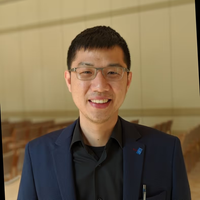

Jin Jack Tan

Profile image


Acoustics Lead at Sorama

Jin Jack Tan is Acoustics Competence Team Lead at Sorama, where he develops acoustic imaging and microphone-array based sensing solutions for real-world environments. His work focuses on translating acoustic signal processing and AI into practical monitoring systems, with applications ranging from predictive maintenance to environmental and live acoustic monitoring. He also led the VIPNOM project, which explores advanced noise measurement using microphone arrays and acoustic virtual reality. Additionally, he also initiated a few other projects at European levels via EUREKA and Horizon Europe funding instruments. He received his PhD from Université Paris-Saclay in 2017.


Live acoustic monitoring at the edge with microphone arrays — Session 2, 11:45–12:00
There is something elegant about acoustic AI at the edge: the same deployment pipeline can connect domains as different as stadiums, industrial plants (with robots), and airports. This talk presents how microphone arrays and NVIDIA Jetson platforms can be used to perform live acoustic monitoring with low latency and actionable outputs. Using examples from these environments, we show how sensing, signal processing, and AI inference are combined in a practical edge deployment pipeline. The talk highlights how these seemingly unrelated domains share common requirements in latency, robustness, and scalability, and what this means for the design of embedded acoustic AI systems.

Javier Ferreira González

Associate Professor at Saxion University of Applied Sciences

Dr. ir. Javier Ferreira Gonzalez is Associate Professor (Lector) in Embedded Systems at the Ambient Intelligence research group at Saxion University of Applied Sciences, where he leads the Connected Embedded Systems research line. He holds a degree in Telecommunications Engineering from the Polytechnic University of Madrid, an MSc in Biomedical Engineering, and a double PhD in Biomedical Engineering from KTH (Sweden) and UPM (Spain). His background spans embedded systems design, IoT architectures, and edge intelligence, informed by industry experience as a founder and CTO in the wearable and smart systems space. His current research focuses on decentralized embedded intelligence, federated IoT, and the deployment of AI at the edge in real-world energy and sensing applications. He has participated in multiple European and national projects.


Embedded Intelligence for Local Energy Systems: From Field Deployments to Edge AI — Session 2, 12:00–12:15
Local energy communities face a dual challenge: managing grid congestion in real time while keeping sensitive energy data within their own boundaries. Solving both locally, without relying on cloud connectivity or centralized infrastructure, requires intelligence directly at the edge. This talk presents applied research carried out with the Aardehuizen energy community in the Netherlands, where a modular IoT framework built on decentralized, lightweight communication protocols supports real-time energy monitoring and local grid support services. A key requirement in this setting is predictive control: anticipating load behavior closely enough to act before congestion occurs. We explore what this means in practice when the target platform is a resource-constrained edge device, presenting results from optimizing GRU-based short-term load forecasting models for embedded deployment. Post-training quantization reduced model size by approximately 6x while achieving sub-millisecond per-step inference on low-power hardware, making day-ahead forecasting viable at the node level. The talk reflects on what building and deploying these systems in a real community setting teaches us about the practical gap between embedded AI research and field-ready solutions.

Charis Kouzinopoulos


Assistant Professor at Maastricht University

Dr. Charis Kouzinopoulos is an Assistant Professor of the Internet of Things at Maastricht University, where he also coordinates the Computer Systems Research Area in the Department of Advanced Computing Sciences. His research is driven by the vision of creating sustainable, low-power, and intelligent systems for the Internet of Things, with applications in digital agriculture, smart cities, healthcare, and Industry 4.0. His expertise includes hardware design and integration, low-power miniaturized systems, algorithm optimization, software-hardware co-design for Edge AI, computer architecture, and high-performance computing.


Hardware-Aware Low-Power Object Detection on STM32U5 — Session 3, 13:15–13:30
This talk presents an optimized edge AI system for object detection in digital agriculture, based on the YOLOv8n object detector deployed on the STM32U575ZI microcontroller, with a specific emphasis on low power consumption. Several compression techniques are applied to the detection model, including structured pruning, integer quantization and input scaling in order to meet strict hardware constraints. The model is trained and evaluated on the CropAndWeed and Lincoln Beet datasets, achieving a balanced trade-off between detection accuracy and efficiency.
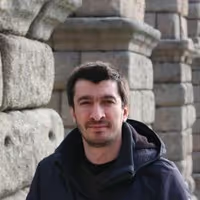

Selcuk Sandikci


AI Architect | Technical Project Leader at NXP

Selcuk Sandikci is an R&D leader with over 15 years of hands-on experience in computer vision, image and signal processing, machine learning, deep learning, imaging, and algorithm design. He has broad professional experience across the defense, aerospace, automotive, security surveillance, and mapping industries. He holds a master’s degree in computer vision and machine learning and has more than 10 years of software engineering experience, including requirements specification, design, unit testing, and integration testing. His expertise includes developing proof-of-concept demonstrators, prototypes, and new product features in close collaboration with engineering teams and customers. His specialties include computer vision, image processing, machine learning, deep learning, data science.


Model and AI Inference Optimization for Resource-Constrained Edge AI Devices  — Session 3, 13:30–13:45. 

Edge AI is becoming essential for delivering intelligent, responsive, and privacy-preserving applications directly on devices, without relying on continuous cloud connectivity. However, running increasingly diverse and complex AI models at the edge requires state-of-the-art model and inference optimization methods to meet strict constraints on latency, power, memory, and cost. In this talk, we discuss how NXP applies and develops state-of-the-art model and AI inference optimization techniques for efficient execution on NXP Edge AI NPUs. We will cover techniques ranging from model quantization and model and token pruning to speculative decoding, showing how these techniques help enable scalable deployment of a wide range of AI models on embedded platforms.


Henk Corporaal

Full Professor at Eindhoven University of Technology

Prof. Henk Corporaal is a Full Professor in the Electronic Systems group at Eindhoven University of Technology (TU/e), specializing in computer architecture and energy-efficient computing systems. He has led numerous large-scale research initiatives in areas such as computation-in-memory, near-memory computing, efficient deep learning, energy-autonomous IoT systems, and wearable healthcare technologies. With a career spanning both fundamental and applied research, and more than 500 publications across fields including accelerators, compilers, deep learning architectures, and high-performance computing, Prof. Corporaal is a leading figure in the development of innovative computing technologies.


Manil Dev Gomony

Assistant Professor at Eindhoven University of Technology

Dr. Manil Dev Gomony is an Assistant Professor at Eindhoven University of Technology and a Researcher at Nokia Bell Labs. His research centers on low-power digital hardware design, covering topics from system architecture to circuit-level implementation, including processor architectures and memory systems. With expertise in designing efficient computing technologies across multiple hardware layers, he contributes to the development of next-generation energy-efficient electronic systems.


Compute-in-Memory (CIM): A Key Enabler for Edge AI — Session 3, 13:45–14:15
Compute-in-Memory (CIM) has emerged as a promising paradigm to overcome the energy and bandwidth bottlenecks of conventional von Neumann architectures, making it particularly attractive for Edge AI. This talk introduces the fundamentals of CIM and reviews the state of the art in performance, efficiency, and scalability. Next we discuss key CIM variants and their application to both artificial neural networks (ANNs) and spiking neural networks (SNNs). Finally, we outline future trends and architectural directions for extending CIM toward more demanding workloads, including large language models (LLMs), in resource-constrained edge environments.


Innatera


Innatera Nanosystems

Innatera is a Delft-based semiconductor company developing neuromorphic processors for the sensor edge. Founded as a spin-off from Delft University of Technology, Innatera designs Spiking Neural Processor architectures that enable ultra-low-power, low-latency pattern recognition in always-on sensing applications. The company recently unveiled Pulsar, its first mass-market neuromorphic microcontroller.


Title TBA — Session 4, 14:30–14:45
Talk abstract to be confirmed.

Mottaqiallah Taouil


Associate Professor at TU Delft

Mottaqiallah Taouil is currently an Associate Professor in the Computer Engineering (CE) Laboratory at the Faculty of Electrical Engineering, Mathematics and Computer Science (EEMCS) at Delft University of Technology (TU-Delft). His expertise is in hardware dependability, and he is also a co-founder of Cognitive-IC, a startup focused on hardware dependability solutions. His research interests include Digital CIM and digital AI chips.


Doing More with Less: Smart Model Compression for Efficient Edge AI — Session 4, 14:45–15:00
The rapid expansion of Edge AI demands intelligent systems that operate within energy, memory, and computational budgets. Although specialized hardware accelerators provide a foundation for efficiency, hardware optimization alone can no longer keep pace with the exploding complexity of modern neural networks. This presentation shifts the focus to the algorithmic frontier, introducing a novel, lightweight framework for joint pruning and quantization. Powered by uncertainty-driven sensitivity scores, this approach eliminates the need for isolated, sub-optimal optimization steps or brute-force search. Crucially, the tool itself features minimal execution time and memory overhead, making the compression process highly efficient. Through experimental results on various datasets, we will demonstrate how this framework drastically reduces model footprints without sacrificing accuracy, unlocking the next generation of scalable and sustainable Edge AI.

Federico Corradi 


Assistant Professor at Eindhoven University of Technology

Dr. Federico Corradi is an Assistant Professor at Eindhoven University of Technology (TU/e), where he leads the Neuromorphic Edge Computing Systems Laboratory. His work explores the design of next-generation neuromorphic and edge computing systems, with a focus on asynchronous circuits, mixed-signal design, and spiking neural networks for applications in robotics and biomedical sensing. Drawing on experience from both academia and industry, including roles at iniLabs and IMEC, he has contributed to the development of neuromorphic processors, event-driven sensors, and innovative hardware architectures. In addition to his research, Dr. Corradi is an active member of the international scientific community, serving in editorial and conference leadership roles while promoting open-source design and interdisciplinary education in brain-inspired computing.

Real-Time FMCW Radar Estimation: Chirp-by-Chirp Signal Processing on Neuromorphic Hardware — Session 4, 15:00–15:15
Conventional FMCW radar processing is limited by frame-based FFTs that require large data buffers and introduce significant latency. This talk presents an event-driven alternative that applies neuromorphic principles to achieve efficient perception at the edge. By using a two-stage Spiking Neural Network (SNN), we process radar signals chirp-by-chirp: Integrate-and-Fire neurons perform initial range estimation, while Resonate-and-Fire neurons extract velocity through frequency-tuned oscillations. This architecture enables high-velocity targets to be detected with fewer chirps, significantly reducing detection latency compared to standard pipelines. We demonstrate how these spike-based strategies, implemented on specialized neuromorphic hardware, overcome the memory bottleneck of traditional 2D FFTs, providing a low-power, low-latency solution for real-time edge AI

Orlando Moreira 

Chief Architect Computer Core at SNAP

Orlando Moreira is the Chief Computer Architect for AI Cores, at Snap Inc. in Eindhoven, Netherlands. His expertise encompasses computer architecture, edge AI, embedded systems, real-time systems, and data flow methodologies. Before Snap Inc., Moreira held the position of Chief Architect at GrAI Matter Labs, where he was responsible for the compute architecture and software development kit (SDK) roadmaps. Over the years, he worked for Philips Research, ST-Ericsson, Ericsson, and Intel (where he was group leader for programming and core tools – compiler, simulator, debugger and hw generation). Throughout his career, Moreira has contributed published work to the field of computer architecture, compilers, modeling and temporal analysis, particularly in the areas of embedded and cyber-physical systems, as well as real-time systems.


Title TBA — Session 4, 15:15–15:30

Farshad Moradi

Full Professor at University of Southern Denmark

Farshad Moradi is a Full Professor at University of Southern Denmark leading SDU Microelectronics focusing the design and development of low-power intelligent sensor interfaces ranging from biomedical applications to IoT sensor nodes for industrial application for the purpose of monitoring or early detection of specific patterns. Before joining SDU, he was a Full Professor at Aarhus University since 2011 to 2025 as the head of Electronics and Photonics section. He has been coordinating several large European and national projects with a focus on novel computing using CMOS, spintronic, or other emerging technologies enabling fast and energy-efficient data processing. He has published more than 200 articles across different fields including computing, biomedical IC design, and Sensor interfacing circuits. He is holding several patents and co-founder of two startups within the domain of biomedical IC design and AI inference.


Emerging Computing Technologies for Neural Interfaces — Session 4, 15:30–15:45
Emerging Computing Technologies for Neural Interfaces: This talk explores the development of brain-inspired brain–computer interfaces (BCIs), covering both circuits and systems for neural interfacing and computing architectures implemented in digital, analog, and emerging technologies such as spintronics, memristors, and CMOS. It highlights applications in brain monitoring and treatment of neurological disorders like Parkinson’s disease and epilepsy. The central focus is on demonstrating the feasibility and potential of neuromorphic computing systems to efficiently process and interface with neural bio signals, enabling next-generation, low-power, and intelligent BCI solutions.


Qinyu Chen

Assistant Professor at Leiden University

Dr. Qinyu Chen is an assistant professor at Leiden University, where she leads the Efficient Intelligence Group at Leiden Institute of Advanced Computer Science. Her research focuses on hardware–software co-design for neuromorphic AI and large language models, with applications in robotics, healthcare, and AR/VR. She received the BRIDGE Fellowship 2022 from the Swiss National Science Foundation and the Talent Program Veni Grant 2024 from the Dutch Research Council. She also actively contributes to the community such as serving as the secretary of IEEE CAS Neural Systems and Applications Technical Committee, track chair of ISCAS (2024 - 2026), organizer of IEEE WICAS-YP (2025) and FPL (2025, 2026), associate editor of IROS (2026) and ICRA (2025), and guest editor of IEEE JETCAS (2026).

Interactive Edge Intelligence for Next-Generation Human–Machine Systems — Session 5, 16:00–16:15
The next generation of interactive edge intelligence systems, such as smart glasses and XR headsets, robots, requires seamless integration of perception, interaction, and intelligent processing. This talk presents a unified framework that bridges human–machine interaction with efficient on-device intelligence. It highlights cost-effective interface designs, including event-based eye tracking, hand tracking, and voice control, alongside energy-efficient edge intelligence solutions such as neuromorphic AI hardware and compact large language models for real-time operation under strict energy and latency constraints. A case study further illustrates how eye gaze signals can guide visual–language models (VLMs), reducing computational workload while enabling adaptive and context-aware interaction.


Luuk Spreeuwers

Associate Professor at University of Twente

Dr. Luuk Spreeuwers is a researcher and academic leader in computer vision, biometrics, and image analysis at the University of Twente. With a career spanning medical imaging, 3D image analysis, pattern recognition, and digital image processing, he has contributed extensively to both research and innovation in the field. He currently leads the Computer Vision and Biometrics subgroup within the Department of Electrical Engineering, Mathematics and Computer Science.


Embedded AI for Computer Vision and Biometrics Applications — Session 5, 16:15–16:30
Computer Vision and Biometrics application, like e.g. face recognition, are typically resource hungry. On the one hand, deep learning and AI developments have drastically improved the performance of image analysis and biometric recognition. On the other hand, this has resulted in a significant increase of the required resources. However, there is also a need for compact and stand-alone systems for image analysis. In the Computer Vision and Biometrics LAB at the University of Twente, we investigate and develop such systems. We develop stand-alone small factor systems for e.g. finger vein and iris recognition that use modest computing platforms like the Raspberry PI. Another application is the use of AI methods for automotive applications like Self Driving Vehicles. In addition, we investigate methods to shrink and adapt large AI models for Computer Vision tasks and Biometric Recognition to fit on modest platforms, like FPGAs. This is a multi-objective optimisation problem that aims to preserve accuracy and throughput as much as possible while reducing memory and computing resources. One of the used techniques is called Network Architecture Search, where the best architecture for a specific platform is found.


Aniek Even 


Project Lead Ingestible Technologies at imec

Dr. Aniek Even is a Principal Scientist and Project Lead for Ingestible Technologies at OnePlanet Research Center. Her work focuses on advancing sensor technologies for preventive health and nutrition, with a particular emphasis on smart pill innovation for gut health monitoring. Since 2019, she has played a leading role in turning this vision into reality, guiding the development of a groundbreaking ingestible sensor prototype that has been validated and applied in clinical trials. With expertise spanning biomedical engineering and health technology innovation, Dr. Even combines scientific leadership with a strong drive to translate research into real-world impact.

A sensor you can swallow: highly miniaturized ingestible technology for real-time, patient-friendly insights into gut health — Session 5, 16:30–16:45
The human gastrointestinal tract is crucial for our overall well-being, yet it remains a black box to a certain extent. Current gold-standard diagnostic tools like endoscopy are invasive and require uncomfortable bowel preparation, while fecal tests offer only partial insights into gastrointestinal (GI) function. Ingestible technology has the potential to unravel this black box by providing a detailed, non-invasive view of the entire GI tract. At the OnePlanet Research Center / imec, two such technologies are being developed: the Gastrointestinal Smart Module (GISMO), a sensing pill, which measures pH, temperature, redox potential, and regional transit times; and a sensor-guided sampling pill that collects targeted intestinal content for offline analysis. These devices were thoroughly validated in pre-clinical in vitro and in vivo models. The sensor pill was successfully tested in a first-in-human trial involving 15 healthy participants and is currently deployed in patient trials. Together, these innovations represent a major step forward in GI diagnostics and monitoring, offering real-time, patient-friendly insights into gut health.